Rebuilding WALL-E: a toy first, a robot second
WALL-E rebuild, work in progress: new body, new brains, and a neck that needed actual math.
- Wall-E
So, what is this, you may ask? Since I’ve only recently started writing about it, let me explain: I’m building a WALL-E replica. A while ago I came across a very interesting and challenging project: a 3D-printed WALL-E by Chillibasket. You can find it here: https://wired.chillibasket.com/3d-printed-wall-e/
The project stuck with me from the start. I told myself that even if I copied it one to one, it would still be worth it. I could build it as a toy for my son, who was six at the time and had only just found the patience to sit through the first 30 minutes of the film.
Many people have published “upgrades” for Chillibasket’s WALL-E, so I went through them carefully and put together my own mix of original and upgraded parts. Eventually everything was printed, assembled and calibrated, and the robot was finished. I loved it, I truly did. But it wasn’t a toy. I couldn’t hand it to my son and say “go ahead.” Controlling it from a web browser on a phone was fine for me, but for a kid it’s asking a lot.
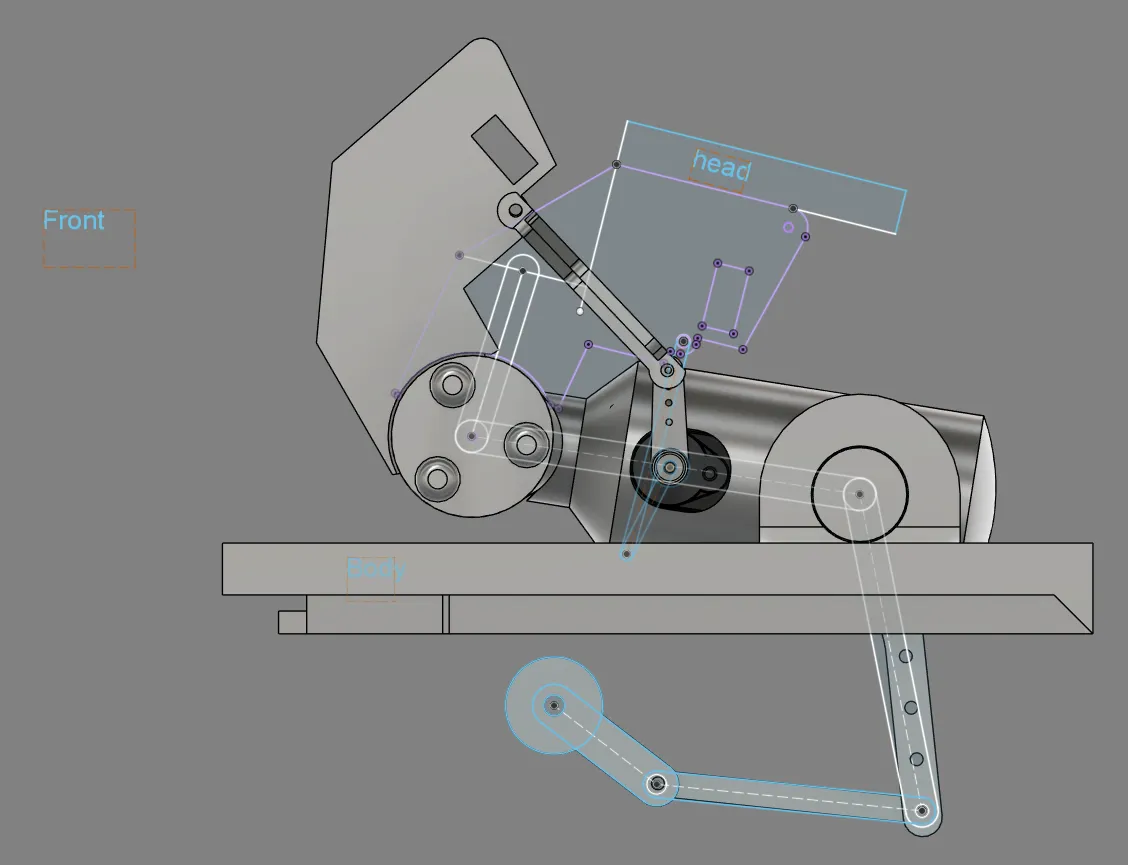
And then I thought: how hard could it be to improve on this? Well, here I am, two years later, trying to figure out the kinematics of the neck, arguably the most complicated joint (or set of joints) in the entire robot.
Starting over
Did I mention that I started rebuilding everything from scratch? The 3D models, the software, everything. And I gave myself a North Star: this has to be a toy that a kid can operate safely, on his own.
I’m not there yet, but I’m making progress. The tracks and motor mounts I kept as they were; that was the easy part. Almost everything else I modified:
- the bottom of the body now fits the battery, the motor controller and the DC-DC converters;
- a mezzanine that ties into the structure carries two ESP32s, one for media and one dedicated to movement and connectivity;
- I moved the whole servo architecture to serial bus servos, hoping for better quality and reliability;
- I questioned every joint for friction and kinematics. As a result, the arms are now supported by bearings, the head sits on a thrust bearing, and there’s much more.
I hope I can finish it and keep sharing updates, and there are some significant ones. What I can say is that I’ve never lost sight of the main goal: this is a toy. In the end it doesn’t matter how hard it is to build. What matters is how easy it is to use.
Today’s challenge: looking around with a game controller
Which brings me to today’s problem. I want to control the robot with a Stadia controller (thanks, Google). The idea is to use the right stick for “looking”, just like in a game: WALL-E’s head and eyes should point wherever the stick tells them to.
The catch is that the head’s position in space depends on two servos, one at the base of the neck and one inside it, and they have to move together, proportionally. I could have gone with trial and error, but this time I chose to plan ahead. I opened Fusion 360, drew simplified joint diagrams and started solving them like I was back in high school. It really took me back, including to the moment I asked, helplessly, “why am I even learning this?” Yeah… karma.