Project overview
High-voltage coolant heaters warm the battery and cabin of electric vehicles. They sit directly on the HV bus, so every design decision is also a safety decision. I owned the system and product landscape of this product family for one OEM: long-running series production on one side, next-generation development on the other.
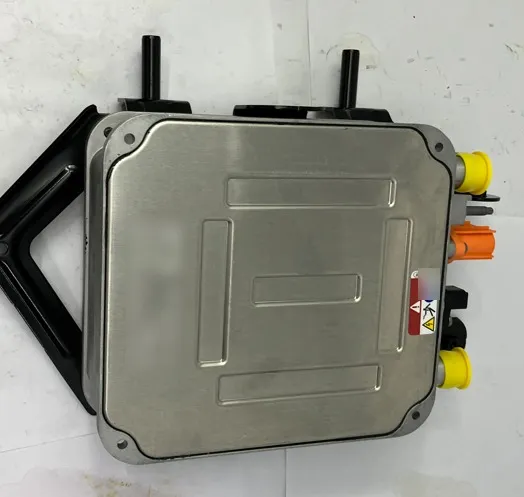
The photo shows the one I am proudest of: the 9 kW heater. It had a turbulent development, was delivered on time, and in my opinion is the best heater we ever built.
Challenging the safety classification
The OEM initially requested ASIL B for this heater. I challenged that requirement with a structured safety argument: the relevant hazards were already fully controlled by the high-voltage safety concept, without a separate functional safety rating. The argument held. The heater was released under high-voltage safety requirements (HVS) instead FuSa.
This avoided the development, verification and documentation overhead of an ASIL B product — cost and time the program did not have to spend, without compromising safety.
The hard part: a heating element at the edge of physics
For strategic reasons, the program had to use a thermally sprayed heating layer on the heater plate instead of the established technology. On paper that was attractive. In practice it pushed power density well beyond what was considered standard and comfortable, and the spray process itself was expensive.
The first plates, bought from an external supplier, behaved well. When production moved in-house, the problems started. After spraying, the heating tracks are shaped by an ablation step, and the geometry is extremely sensitive: at HV bus voltage, a few ohms decide the instantaneous power. A sharp corner in a track turned into a hotspot magnet, and any small imperfection became a potential failure point.
Protecting the product in software
I developed a heater protection algorithm that detects the onset of critical thermal behaviour and keeps the element inside a safe operating window, long before a local hotspot can turn into damage. Getting it into the product took persistence: it needed several rounds of convincing before the software team implemented it.
In parallel, program management made the decisive call to move the heating layer from thermal spray to screen printing. It was the more expensive route but avoided significant risks. With the protection algorithm recalibrated on the new plates, the combination proved remarkably robust.
EOL and calibration
With DV and PV passed and industrialization ahead, the plant came back with a clear demand: lower the takt time. One of the main bottlenecks was the end-of-line test, which at that point was the standard sequence used for every other OEM.
That put me on the next plane to Viana. Within two weeks I developed a new EOL and calibration process that cut more than 30 seconds from the overall takt time. My EOL and calibration method has since become the standard.
What this project demonstrates
Challenging a customer requirement with engineering arguments instead of accepting it by default, and ownership of a safety-critical, high-volume product end to end: seeing a physical risk early, building a technical safeguard for it, pushing it through the organisation, supporting the hard program decision that fixed the root cause, and taking it all the way into the factory, in overalls.